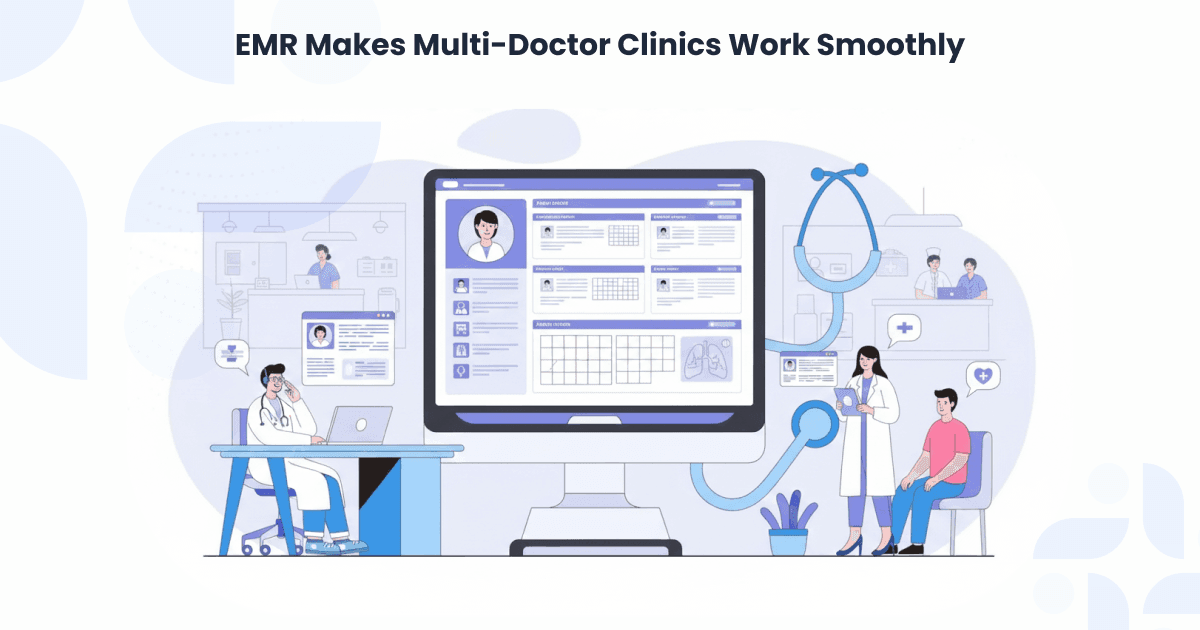
Running a clinic with multiple doctors is not easy. As the number of doctors increases, patient flow increases, staff work increases, and coordination becomes more difficult. Many multi-doctor clinics still depend on paper files, registers, and WhatsApp messages. This often leads to confusion, delays, and mistakes.
An EMR system like Healcard helps solve these problems by bringing everyone onto one digital platform, making it an ideal EMR for multi-doctor clinics. Let’s understand how EMR makes multi-doctor clinics work smoothly, step by step.
What Is an EMR System?
An EMR (Electronic Medical Record) system is a simple digital way to keep patient records on a computer or mobile device, also known as electronic medical records for clinics.
Instead of maintaining paper files, all patient information is stored digitally in a single, secure location. This makes it easy for doctors and clinic staff to find and update records anytime.
An EMR system stores details such as:
- Patient registration information
- Previous visit history
- Doctor’s notes
- Prescriptions
- Lab test reports
- Billing and payment details
Only authorized doctors and staff can access this information, so the data stays safe and private.
In short, an EMR system like Healcard helps clinics and hospitals work faster, stay organized, and give better care to patients without the hassle of paper files
Common Problems in Multi-Doctor Clinics Without EMR
Without EMR, multi-doctor clinic management becomes difficult, and clinics usually face these daily issues:
- Patient files get lost or mixed up
- The same patient is registered again and again
- Doctors cannot see the previous treatment history
- Staff get confused about which doctor the patient is visiting
- Billing errors happen frequently
- Lab and pharmacy coordination becomes slow
These problems waste time and create stress for doctors, staff, and patients.
How EMR Makes Multi-Doctor Clinics Run Smoothly
Step 1: One-Time Patient Registration
In an EMR system, a patient is registered only once.
Each patient gets one digital file that all doctors can use.
There are no duplicate entries, no repeated paperwork, and no confusion.
This saves time for both staff and patients.
Step 2: Doctor-Wise OPD Made Easy
While registering the patient, the staff selects the doctor.
Each doctor has their own OPD queue, so patients don’t get mixed up.
Doctors clearly see their patient list and can work without interruptions.
Step 3: Shared Patient History for All Doctors
If a patient visits another doctor in the same clinic, the new doctor can see past visits, notes, prescriptions, and reports.
Patients don’t need to repeat their history again and again.
This leads to better treatment and builds patient trust.
Step 4: Clear Doctor-Wise Notes and Prescriptions
Every doctor writes their own notes and prescriptions in the EMR.
Records are clean, readable, and properly saved.
There is no confusion about who treated the patient.
Everything stays well organized.
Step 5: Easy Lab and Pharmacy Coordination
Doctors add lab tests digitally.
Lab reports are uploaded directly to the patient’s record.
Prescriptions reach the pharmacy instantly.
This removes paper slips, reduces delays, and avoids errors.
Step 6: Simple and Accurate Billing
EMR automatically handles OPD and billing management, reducing manual work and errors.
Doctor-wise consultation fees are added correctly.
Bills can be combined or kept separate as needed.
This makes payments clear and reduces billing problems.
Step 7: Safe Role-Based Access
EMR gives access based on staff roles.
Reception handles registration, doctors manage treatment, and admins view reports and billing.
Patient data stays safe and secure.
Benefits of EMR for Doctors
Overall, these EMR benefits for doctors help them work better, faster, and with less stress.
- Less paperwork: Doctors don’t need to write everything on paper. All patient details, prescriptions, and reports are saved digitally.
- More time with patients: Because records are quick to open and update, doctors save time and can give more attention to patients.
- Easy access to patient history: Past visits, medicines, and reports are available in one place, anytime, with just a few clicks.
- Reduced stress: No missing files or confusing handwriting. Everything stays organized and easy to manage.
- Better coordination with other doctors: All doctors in the clinic can see the same patient record, which avoids confusion and improves treatment.
Overall, EMR systems like Healcard help doctors work better, faster, and with less stress.
Benefits of EMR for Patients
EMR also makes life easier for patients. When records are digital, the whole clinic visit becomes smoother and less stressful.
- Faster consultations: Doctors can quickly see records on the screen, so less time is spent on paperwork and more time on treatment.
- No need to carry files: Patients don’t have to bring paper files every time. All reports and prescriptions are stored safely in the system.
- No repeated tests: Old test reports are already available, so doctors don’t ask for the same tests again, saving money and time.
- Clear digital prescriptions: Digital prescriptions are easy to read, so there is no confusion about medicines.
- Better continuity of care: Even when patients meet a different doctor, their full history is available, ensuring better and consistent treatment.
Overall, EMR makes healthcare simple, fast, and patient-friendly.
Is EMR Useful for Small Clinics with 2–3 Doctors?
Yes, EMR is very useful, even for small clinics with 2–3 doctors.
In small clinics, doctors often share patients. With paper files, it becomes hard to find records, check past treatments, or know what another doctor has done. This can create confusion and waste time.
EMR keeps all patient information in one place. Any doctor can easily see reports, prescriptions, and visit history in a few seconds. It makes daily work faster and more organized.
EMR is simple to use, affordable, and helpful from the first day, which is why EMR software in India is becoming popular among small and growing clinics. As the clinic grows, EMR grows with it. That’s why EMR is a smart choice for small clinics too.
FAQs: EMR Makes Multi-Doctor Clinics Work Smoothly
EMR (Electronic Medical Record) is software that stores patient details digitally, like visits, prescriptions, lab reports, and billing, all in one place.
Yes! Modern EMRs allow many doctors and clinic staff to work together on the same system. Everyone sees up‑to‑date patient information, so there’s no confusion or data loss.
Absolutely. EMR systems let doctors order lab tests digitally and get reports attached right to the patient’s record. Prescriptions can go to the pharmacy electronically. This avoids paper slips and speeds up service.
EMR is useful for both. Even small clinics with 2–3 doctors benefit from faster record access, fewer mistakes, better patient history tracking, and easier billing. The system grows with the clinic as it expands.
Yes. Many EMR platforms include billing modules that automatically add consultation fees, lab charges, and other services, reducing errors and speeding up payments.
Most EMR solutions support data migration from old systems, spreadsheets, or digital files, so records are not lost. Clinics should check with the vendor about migration support.
Final Thoughts
Running a multi-doctor clinic can be stressful without proper organization. Paper files, duplicate records, and miscommunication waste time and energy.
An EMR system like Healcard solves this by keeping everything, patient records, prescriptions, lab reports, and billing, connected in one place, making it a complete solution for modern clinics. Doctors work smoothly, staff stay organized, and patients get faster, better care.
Ready to Simplify Your Clinic?
Discover Healcard, the all-in-one EMR & Scheduling App trusted by doctors and clinics.
📧 Email: support@healcard.com
🌐 Website: healcard.com
✨ Make your clinic & hospital smarter with Healcard!