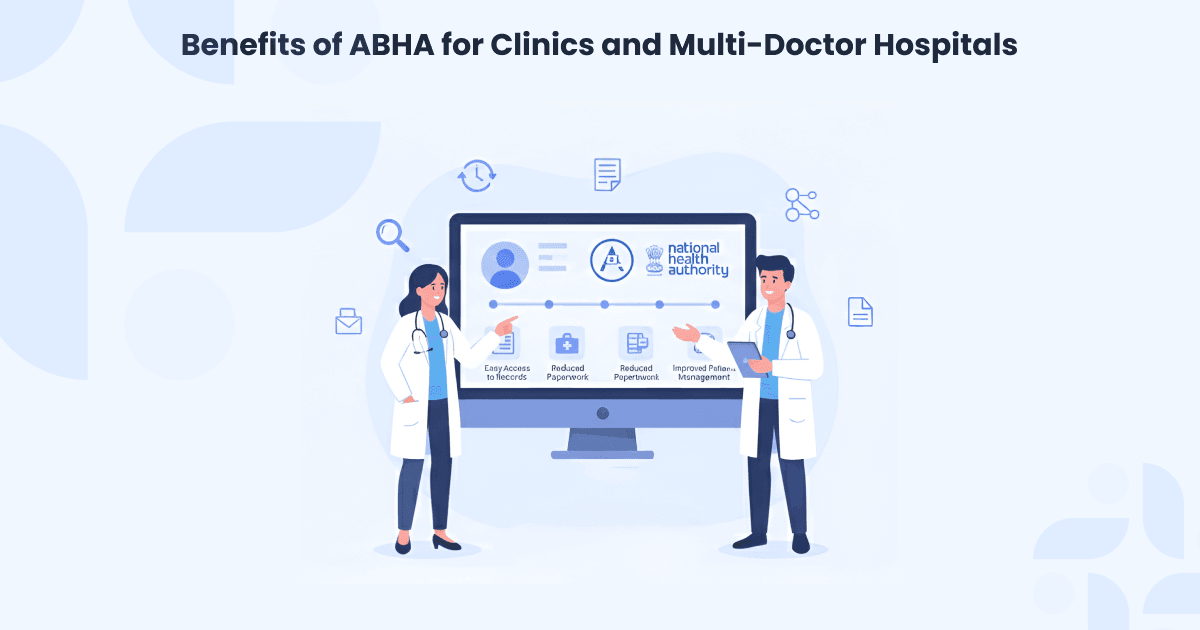
Digital healthcare is growing fast in India. Clinics and hospitals are seeing this change every day. Managing patient files, handling many doctors, and reducing paperwork have become very important.
This is where ABHA (Ayushman Bharat Health Account) helps clinics and hospitals manage patient data more efficiently.
ABHA is a digital health ID for patients in India that keeps medical records in one safe place, making digital health records easier to manage and access. For clinics and multi-doctor hospitals, this means less paperwork and less confusion. Doctors can see patient history easily (with permission), and staff can save time that is usually spent finding files.
Healcard makes this process even smoother through ABHA and EMR integration, allowing clinics to access ABHA-linked records directly inside their clinic software. so staff and doctors can access records instantly without switching between systems.
What Is ABHA?
ABHA(Ayushman Bharat Health Account) is a unique digital health ID for every patient under the Ayushman Bharat Digital Mission (ABDM), offering key ABDM benefits for hospitals and clinics. It gives you a special ABHA number and a digital health record linked to it. With your permission, doctors, clinics, and hospitals can access and update your medical information like prescriptions, lab reports, diagnoses, and visit history. This makes your healthcare faster, easier, and more organized.
Why ABHA Is Important for Clinics and Hospitals
ABHA is useful for clinics and hospitals because it keeps all patient health records in one digital place, highlighting the benefits of ABHA for hospitals in daily operations. This means doctors and staff can see a patient’s medical history quickly, without asking the same questions over and over or worrying about lost paper files. It makes running a clinic easier and care better for patients.
- Patients don’t need to register again and again
- Doctors can see the full medical history anytime
- Paper files won’t get lost
- Doctors don’t have to repeat the same questions
- Clinic work becomes faster and smoother
Key Benefits of ABHA for Clinics and Hospitals
1. Faster Patient Registration
With ABHA, patients don’t need to fill out the same forms every time they visit. Reception staff can quickly pull up patient details using the ABHA number, reducing waiting times. This makes registration smooth and saves time for both patients and clinic staff. This is one of the most practical ABHA benefits for clinics, especially busy OPDs and reception areas.
2. Centralized Digital Health Records
ABHA keeps all patient records in one place. With the patient’s consent, clinics can access past prescriptions, lab reports, and diagnoses. Everything is organized digitally, so doctors can easily see a patient’s medical history, making follow-ups and treatment decisions easier and faster.
3. Better Coordination Between Multiple Doctors
In hospitals with more than one doctor, ABHA ensures that every doctor can see the same patient records. This reduces unnecessary tests, avoids repeating treatments, and makes referrals between departments smoother. It improves medical decisions and prevents confusion.
4. Reduced Administrative Work
ABHA helps clinics cut down on paperwork, manual data entry, and duplicate records. Staff spend less time managing files and more time assisting patients. This not only saves time but also reduces operational costs over the long term.
5. Improved Patient Trust and Experience
Patients feel confident knowing their records are safe, organized, and accessible when needed. They don’t have to repeat their medical history at every visit and can control who can see their data. This builds trust and gives the clinic a modern, professional image.
6. Easy Integration with EMR and Hospital Software
ABHA works seamlessly with Electronic Medical Records (EMR) and Hospital Management Systems (HMS), making ABHA and EMR integration smooth and reliable. It allows automatic record updates, smooth data sharing between systems, and makes it easier for clinics and hospitals to grow without facing data management problems.
7. Enhanced Data Security and Privacy
ABHA ensures that patient information is stored securely and shared only with authorized personnel. Clinics and hospitals can follow privacy rules easily, reducing the risk of data leaks or misuse. Patients feel safe knowing their sensitive health information is protected.
Benefits of ABHA for Multi-Doctor Hospitals
- Shared patient data across departments: With ABHA for multi-doctor hospitals, every department can access the patient’s health information easily. This means lab results, prescriptions, and past visits are available instantly, saving time and reducing repeated tests.
- Smooth referrals between doctors: When a patient needs to see a specialist, referrals become seamless. Doctors can share records directly, making the process faster and more accurate.
- Standardized records for all clinicians: ABHA ensures that all doctors follow the same format for patient records. This consistency reduces confusion and makes it easier for any doctor to understand the patient’s history.
- Easier follow-ups and long-term care: With complete records stored in one place, tracking patient progress over time becomes simple. Doctors can plan treatments more effectively and ensure patients get continuous care.
- Better workflow management: Hospital staff spend less time on paperwork and manual data entry. This improves coordination among doctors, nurses, and administrative teams, so the hospital runs more smoothly.
- Enhanced patient safety: Having accurate and up-to-date information reduces the risk of errors in diagnosis, medication, or treatment. Patients get safer, more reliable care.
Healcard supports all these benefits of ABHA for hospitals by connecting ABHA data to hospital workflows and enabling real-time access for every doctor and department.
How ABHA Helps Clinics Become Future-Ready
ABHA makes it easier for clinics to go digital, showing how the Ayushman Bharat Health Account for clinics supports the future of healthcare. With ABHA, clinics can follow government health programs without hassle and take part in national health initiatives easily.
It also makes online consultations and telemedicine simple, so doctors can help patients from anywhere. This means less paperwork, faster service, and smoother management of patient records.
Clinics using ABHA also stand out from others that are still working the old way. Being part of the digital health system builds trust with patients and brings more opportunities.
Healcard ensures your clinic is fully future-ready linking ABHA IDs to telemedicine, online consultations, and EMR updates effortlessly.
How Clinics Can Start Using ABHA
- Basic Requirements: First, make sure your clinic has the necessary digital setup: a computer, an internet connection, and basic patient management software. This is all you need to begin.
- Linking ABHA with Clinic Software: Your clinic software can connect directly with the ABHA system. Once linked, patient records can be easily updated, and new ABHA IDs can be created without extra paperwork.
- Staff Training Overview: A short training session is enough for your staff. They’ll learn how to register patients, update records, and access health information through ABHA. It doesn’t take long, and it makes their work much easier.
- Simple Onboarding Process: Onboarding patients is straightforward. Collect their basic details, create an ABHA ID, and link it to their records in your software. After this, all patient data can be accessed digitally, making your clinic more organized and efficient.
FAQs: ABHA for Clinics and Multi-Doctor Hospitals
An ABHA number is a 14‑digit unique digital health ID that lets patients and healthcare providers access and share medical records securely across connected systems.
No, creating an ABHA ID is voluntary, but many hospitals and clinics encourage it to make registration and record‑sharing faster and smoother.
Yes, both public and private clinics and hospitals registered under the Ayushman Bharat Digital Mission can use ABHA, gaining practical ABDM benefits for hospitals through secure digital record access (with consent).
ABHA stores medical history and records digitally, so clinics don’t need to manage or search for paper files, reducing manual work and mistakes.
Yes, doctors can view linked records online during teleconsultations if the patient gives permission.
Clinics need an ABHA‑compatible management or EMR system that connects with the ABDM network so patient data can be stored and accessed digitally.
No, ABHA itself is just a digital health record system. It doesn’t provide insurance or free treatment; separate from government schemes.
Conclusion
ABHA makes life easier for clinics and multi-doctor hospitals. It keeps patient records in one place, saves time, reduces paperwork, and helps doctors give better care. With tools like Healcard, clinics can link ABHA IDs, securely manage records, and run smoothly. Going digital with ABHA is a simple way to make clinics more organized, efficient, and patient-friendly.
Ready to Simplify Your Hospital?
Discover Healcard, the all-in-one EMR & Scheduling App trusted by doctors and hospitals.
📲 Try a free demo of Healcard today. Manage your hospital digitally, securely, and effortlessly.
📧 Email: support@healcard.com
🌐 Website: healcard.com
✨ Make your clinic & hospital smarter with Healcard!