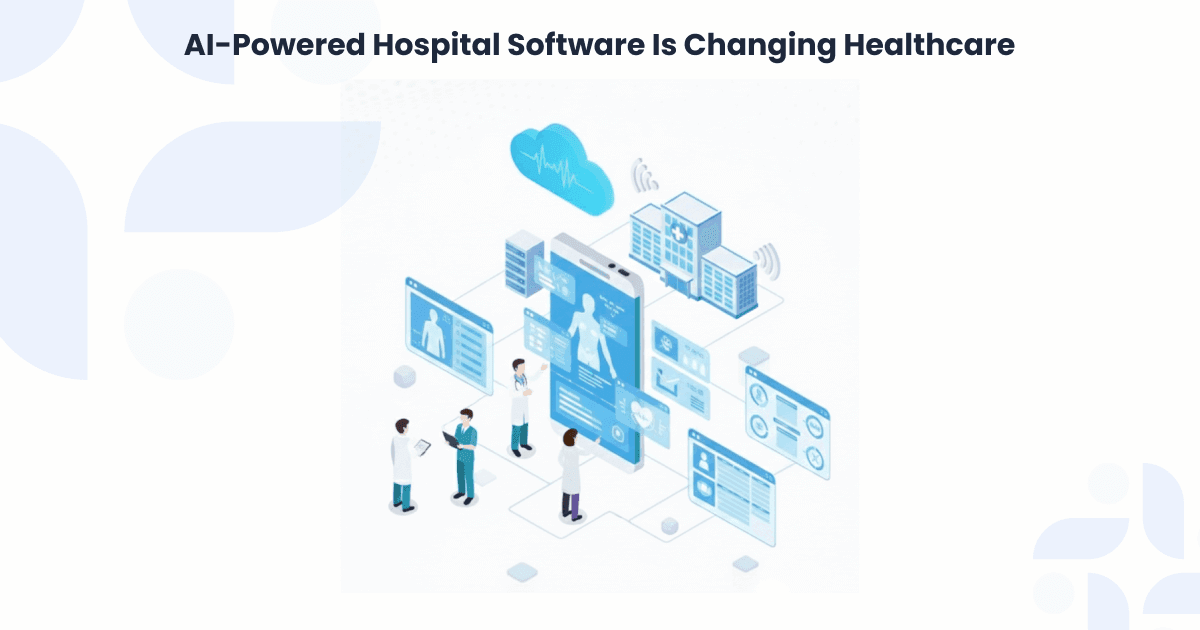
Healthcare is changing faster than ever before. Hospitals today handle a huge number of patients, medical records, reports, bills, and daily operations. Doctors and staff work very hard, but manual processes, paperwork, and outdated systems often lead to delays, errors, and increased stress.
This is where AI-powered hospital software is making a big difference.
Artificial Intelligence (AI) is no longer a future concept. AI healthcare technology is already helping hospitals improve patient care, reduce workload, and make better decisions. In this blog, we will explore how AI-powered hospital software is transforming healthcare simply and practically.
What Is AI-Powered Hospital Software?
AI-powered hospital software is a digital system that uses Artificial Intelligence and machine learning to perform tasks intelligently instead of just following fixed instructions.
Traditional hospital software only stores data and performs basic functions. AI-powered platforms like Healcard HMS go a step further.
- Analyze data
- Learn from patterns
- Predict outcomes
- Support doctors and staff in decision-making
Examples include AI-powered EMR systems, AI-based diagnostics, automated scheduling, and predictive analytics tools.
Problems with Traditional Hospital Systems
Before understanding the benefits of AI, let’s look at common problems hospitals face with traditional systems:
- Too much paperwork and manual data entry
- Long patient waiting times
- Errors in prescriptions, reports, and billing
- Difficulty managing large patient data
- Lack of coordination between departments
- Doctors are spending more time on screens than with patients
These issues affect both patient experience and hospital efficiency.
How AI Improves Patient Care
One of the biggest advantages of using AI in hospitals is that it helps provide better care for patients.
- Faster and More Accurate Diagnosis: AI healthcare technology can quickly analyze a patient’s symptoms, medical history, and test results to help doctors identify diseases more accurately and efficiently. This means patients get the right treatment sooner.
- Support for Doctors’ Decisions: An AI-powered EMR system can suggest possible diagnoses or treatment options based on medical data. Doctors make the final call, but AI helps them avoid mistakes and make better decisions.
- Catching Diseases Early: By studying a patient’s history and test results, AI can spot potential health problems early. This helps prevent serious complications before they happen.
- Personalized Treatment: Every patient is unique. AI helps doctors create treatment plans that are tailored specifically for each person, improving the chances of successful outcomes.
AI in Hospital Operations and Administration
AI is not only helping doctors treat patients, but it is also making hospital work easier and faster. Many daily tasks that once required a significant amount of time can now be completed smoothly with the help of AI.
- Smart Appointment Scheduling: AI helps plan appointments more effectively by understanding patient flow and visit times. This reduces long waiting lines and overcrowding in hospitals.
- Automated Patient Registration: AI-based hospital management collects patient details quickly, reducing paperwork and saving time for both patients and hospital staff.
- Efficient Billing and Insurance Processing: AI checks billing details automatically, reduces errors, and speeds up insurance claims, making payments less stressful.
- Staff and Resource Management: AI helps hospitals manage doctors, nurses, and equipment more efficiently by predicting daily needs and workload.
AI-Powered EMR and Medical Records Management
Managing patient records is one of the biggest challenges for hospitals and clinics. Doctors and staff deal with large amounts of data every day patient history, reports, prescriptions, and follow-ups. Doing all this manually takes time and can lead to mistakes.
AI-powered EMR (Electronic Medical Records) systems make this work much easier and smarter.
- Automatic patient record updates: Patient history is updated automatically after every visit, test, or prescription. This reduces manual work and errors.
- Smart search for quick access: Doctors can find patient records instantly by searching a name, phone number, or condition, no more searching through files.
- Voice-to-text notes for doctors: Doctors can speak, and the system converts their voice into written notes. This saves time and lets doctors focus more on patients.
- Alerts for safety and follow-ups: AI healthcare technology gives alerts for allergies, medicine interactions, missed follow-ups, and important reminders, improving patient safety.
- Better accuracy and data security: AI reduces human mistakes and keeps patient data safe with secure access and backups.
Role of AI in Diagnostics and Medical Imaging
AI is playing an important role in modern healthcare, especially in diagnostics and medical imaging. It helps doctors find health problems faster and more accurately.
- Radiology Support: AI can look at X-rays, CT scans, and MRI images in just a few seconds. It helps spot problems like fractures, infections, or unusual growths and points them out to the doctor. This saves time and reduces the chances of missing important details.
- Faster Reports: Preparing scan reports usually takes time. AI helps by speeding up this process, so doctors get reports quickly. This means treatment can start sooner, which is very important for patients.
- Support for Doctors, Not Replacement: AI does not replace doctors. It only helps them by reducing their workload. Doctors always check the results themselves and make the final decision. AI simply makes their work easier and faster.
AI for Predictive Analytics and Smarter Decisions
- Knowing patient flow in advance: AI can predict how many patients may come to the hospital and when they might be discharged. This helps hospitals manage beds, staff, and resources properly.
- Finding high-risk patients early: By looking at patient records and test results, AI can point out patients who may face health problems. Doctors can then give extra care before the condition becomes serious.
- Preparing for disease outbreaks: AI can notice patterns in symptoms and cases. This helps hospitals get ready for possible disease spread and take early action.
- Better treatment decisions: AI learns from past treatments and outcomes. This helps doctors choose treatments that have worked well for similar patients before.
Benefits of AI-Powered Hospital Software
AI-powered hospital software helps everyone in the healthcare system: patients, doctors, and hospitals. It makes daily work smoother, faster, and more accurate.
For Patients
- Shorter waiting times: Hospital software with AI ensures faster appointments and that reports are generated quickly.
- Better care: AI helps doctors diagnose and treat more accurately.
- Better experience: Everything from booking to discharge becomes smoother.
For Doctors
- Less paperwork: Routine tasks are done by an AI-powered EMR system
- Smart support: AI-based hospital management gives helpful reminders and insights.
- More time for patients: Doctors can focus on caring for people, not forms.
For Hospitals
- Runs more efficiently: Workflows are smoother and faster.
- Fewer mistakes: Automation reduces errors in records and billing.
- Saves money: Less manual work means lower costs.
- Builds trust: Quick and accurate service makes patients happy and confident.
Platforms like Healcard help bring all these benefits into one easy-to-use system.
Challenges and Concerns of AI in Healthcare
AI is a powerful tool, but it comes with some challenges:
- Protecting patient data: Keeping medical records safe and private is very important.
- High setup costs: Installing AI systems can be expensive at first.
- Training staff: Doctors and nurses need proper training to use AI correctly.
- Ethical and accuracy issues: AI can make mistakes, so we need to make sure its data and decisions are correct.
- Reliance on technology: If the system fails, it can cause problems.
Because of these challenges, AI should assist doctors and healthcare staff, not replace them. Human supervision is always necessary.
The Future of AI in Hospital Software
The future of healthcare is smart, easy, and connected.
In the coming years, AI healthcare technology will help hospitals work faster and better. Many daily tasks will be automated, and AI-powered EMR systems will continue learning to improve care. Surgeries will become safer with the help of AI tools that support doctors during operations.
Patients will also get help from virtual health assistants. These assistants can remind them about medicines, appointments, and answer basic health questions. AI systems will keep learning over time, which means healthcare services will keep improving.
AI will also help bring good healthcare to people living in remote and rural areas, where hospitals and specialists are not easily available.
AI will not replace doctors. Instead, it will support them and make their work easier, faster, and more accurate.
Conclusion
AI-powered hospital software is making healthcare faster, smarter, and more patient-friendly. It reduces paperwork, improves accuracy, and helps doctors spend more time with patients instead of managing systems. AI does not replace doctors; it supports them in giving better care.
With growing patient needs, hospitals must move toward smart technology. Healcard helps hospitals and clinics adopt AI-powered solutions easily, manage daily work smoothly, and provide better healthcare with confidence.
📲 Try a free demo of Healcard today. Manage your clinic digitally, securely, and effortlessly.
📧 Email: support@healcard.com
🌐 Website: healcard.com
✨ Make your clinic & hospital smarter with Healcard!
FAQ: AI-Powered Hospital Software
AI-powered hospital software is a smart computer system that helps hospitals manage patient records, appointments, reports, and billing automatically. It uses AI to make work faster, easier, and more accurate.
AI helps doctors by saving time. It reduces paperwork, shows important patient information quickly, and gives helpful reminders. This allows doctors to focus more on patients instead of computers.
No. AI will not replace doctors. It only supports them. Doctors always make the final medical decisions. AI just makes their work easier and faster.
Common examples include AI-powered EMR systems, medical imaging analysis, smart appointment scheduling, predictive analytics for patient risk, automated billing, and virtual health assistants.
AI analyzes scans like X-rays, CT scans, and MRIs quickly and highlights possible issues for doctors. This speeds up diagnosis and reduces the chances of missing critical details.
Yes, many AI-powered hospital systems are designed for small hospitals and clinics as well. Cloud-based solutions make it affordable and easy to scale as the hospital grows.