Doctors have one of the busiest jobs in the world. They spend most of their day seeing patients, reviewing test results, and making important care decisions. But there’s another part of their job that often takes even more time: paperwork. Writing patient records, making notes, managing prescriptions, and checking lab reports can eat up hours every day that could be spent directly helping patients.
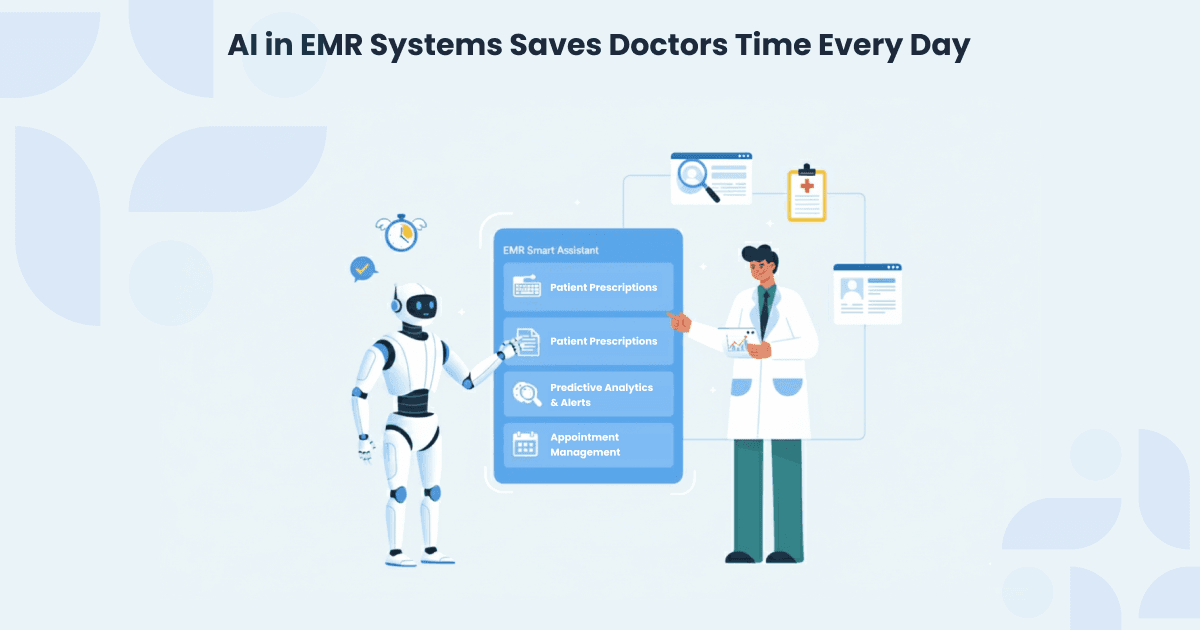
This is where AI (Artificial Intelligence) in EMR (Electronic Medical Record) systems makes a big difference. AI can handle routine tasks automatically and give doctors helpful insights, making their work faster and easier. In simple words, AI in EMRs helps doctors spend less time on paperwork and more time taking care of patients. This is exactly how AI saves doctors time every single day.
What Is AI in EMR Systems?
EMR systems are basically digital versions of patient files. They store things like the patient’s medical history, test reports, prescriptions, and other important details. They are easier than paper records, but doctors still spend a lot of time typing, searching, and organizing information.
When AI is added to EMR systems, everything becomes smarter and faster, creating truly AI-powered EMR systems that understand and organize information intelligently. AI can read and understand the information automatically, so doctors don’t have to enter every detail manually. It can organize data, point out important updates, and even suggest possible treatments based on records.
In simple words, AI changes EMRs from just a digital folder into a smart helper that saves doctors time and helps them work more efficiently.
Daily Tasks AI Can Automate for Doctors
AI can help doctors in many ways during their daily routine, and this EMR automation with AI makes everyday clinical work far more efficient. Here are some of the most important tasks; these are also considered some of the best AI features in EMR systems today:
1. Patient Data Entry
Doctors often lose valuable time typing patient complaints, medical history, and examination notes into the EMR. AI makes this process much easier.
- Doctors can speak naturally, and AI will convert the voice into clean, structured digital notes.
- It can also read scanned documents or handwritten notes and turn them into digital EMR entries.
This reduces manual typing, minimizes mistakes, and saves several minutes per patient.
2. Clinical Documentation
Preparing discharge summaries, progress notes, prescriptions, and case reports takes a lot of effort.
AI can automatically generate draft documents using patient data already available in the system. Doctors only need to review, edit if needed, and approve.
- Less paperwork
- Fewer repetitive tasks
- More time for diagnosis and patient interaction
3. Lab Report Checking
Doctors get many lab reports every day. Reading each one carefully takes time.
- Highlight important or abnormal results
- Compare with older reports
- Give a summary
This helps doctors quickly understand what needs attention.
4. Appointment Management
Managing appointments manually can lead to delays and confusion, which is why AI appointment management in clinics has become so important.
- Suggest the best time slots
- Reduce waiting time
- Prevent double bookings
- Make the schedule smoother
This helps both doctors and patients.
5. Prescription Assistance
AI can also help with writing prescriptions.
Based on the patient’s symptoms, allergies, and medical history, AI can suggest:
- Suitable medicines
- Correct dosage
- Duration of treatment
- Possible drug interactions
The doctor still makes the final decision, but AI prepares a safe and accurate draft prescription, saving several minutes per patient.
6. Follow-Up & Reminder Automation
Doctors often need to remind patients about follow-ups, medicines, tests, or vaccinations. Doing this manually is not possible every day.
AI can send:
- Automatic reminders for medicines
- Alerts for upcoming appointments
- Notifications when reports are ready
- Follow-up reminders after discharge
This improves patient care, ensures treatments are followed properly, and reduces the number of missed appointments.
Benefits of AI in EMR for Time Management
There are many benefits of AI in EMR, and one of the biggest is that it helps doctors save a huge amount of time every single day. Here’s how AI makes a real difference:
1. Reduces Administrative Work
Doctors spend a lot of time on paperwork, writing notes, entering patient history, generating reports, and managing appointments. AI takes over these repetitive tasks so doctors don’t have to do everything manually.
- Less typing
- Less paperwork
- Less stress
Doctors can focus more on diagnosing and treating patients instead of sitting in front of a computer.
2. Minimizes Errors
Manual data entry often leads to mistakes, wrong spelling, missed information, mixed-up reports, etc. These errors take extra time to find and correct later.
AI reduces human errors by automatically capturing, organizing, and updating medical records correctly.
Fewer mistakes means:
- No need to recheck files
- No wasting time correcting errors
- Smooth and clean records every time
3. Faster Decision-Making
AI can quickly scan a patient’s medical history, lab reports, prescriptions, and symptoms.
It highlights what’s important, like abnormal values, critical conditions, or patterns in the patient’s health.
This helps doctors:
- Understand the patient case faster
- Make decisions quickly
- Start treatment without delay
Instead of searching through pages of files, AI brings the right information to the doctor instantly.
4. Improves Workflow
When AI handles routine tasks, the entire clinic runs more smoothly.
Staff members don’t have to run behind files or manually coordinate everything.
AI helps in:
- Managing OPD flow
- Organizing appointments
- Tracking patient progress
- Automating routine reminders
Doctors get a more organized workday with fewer interruptions and more productive hours.
5. Quick Access to Patient History
AI organizes every patient’s past reports, prescriptions, and diagnoses neatly.
So instead of searching through old files, doctors get all details within seconds with one click.
This saves time during busy OPD hours.
6. Automatic Follow-Ups and Reminders
AI sends automatic reminders for appointments, medicines, tests, and follow-ups. Doctors and staff no longer have to manually call every patient.
- Missed appointments
- Last-minute rush
- Extra workload on reception staff
It also keeps patients regularly engaged with the clinic.
7. Better Coordination Between Departments
In hospitals, AI helps different departments like lab, pharmacy, and radiology stay connected.
Doctors don’t need to call or send staff to follow up.
Reports and results appear automatically in the EMR. This saves several minutes for every patient.
Real-Life Examples
Let’s see how AI is saving doctors time. Here are two simple real-world examples that show how powerful AI can be:
- Small Clinic Example: A busy family clinic in India implemented an AI-powered EMR system. Doctors reported that AI reduced documentation time by nearly 50%, giving them an extra 2–3 hours each day to see more patients.
- Hospital Example: A multi-specialty hospital used AI to analyze lab reports and generate automatic summaries. Doctors no longer had to manually review every test result, which sped up decision-making and patient treatment.
These examples show that AI in EMR Systems isn’t just a theoretical idea; it’s already making a measurable difference in doctors’ daily routines.
How Clinics Can Implement AI in EMR Systems
| Step | What It Means |
| Choose the Right EMR System | Pick an EMR that already has AI features like auto data entry. Choosing the right AI-powered EMR system makes adoption much easier. smart reports and predictions. |
| Train Your Staff | Teach doctors, nurses, and staff how to use the AI tools without confusion. |
| Integrate With Existing Systems | Connect the AI-enabled EMR with appointments, billing, labs, pharmacy, and HMS. |
| Start Small & Expand | Begin with simple AI features like auto-fill or voice-to-text, then use advanced features later. |
| Ensure Data Security | Make sure the EMR has strong data protection so patient information stays safe. |
| Automate Repetitive Tasks | Use AI to handle routine work like reminders, follow-ups, and prescription notes. |
| Track Performance | Use AI dashboards to see clinic trends like OPD load, patient history, and revenue. |
| Keep the System Updated | Regularly update the EMR so you get the latest AI features and improvements. |
The Future of AI in EMR Systems
AI is quickly improving healthcare. AI-powered EMR systems will get even smarter, save time, and make care easier for both doctors and patients.
1. Predictive Diagnosis
AI can study a patient’s medical history, symptoms, lab results, and patterns to predict health problems before they become serious. This helps doctors start treatment early and reduce complications.
2. Automated Follow-Ups
AI will automatically schedule follow-up visits, send reminders for medicines, and inform patients about upcoming tests. This reduces missed appointments and ensures better patient care.
3. Smart Decision Support
AI will give doctors smarter treatment suggestions based on patient history, global research, and the latest medical guidelines. This helps doctors make faster and more confident decisions.
4. Voice-to-Text Clinical Notes
Doctors will soon be able to speak naturally while AI converts their voice into clean, structured medical notes. No typing, no manual entry, just faster documentation.
5. AI-Powered E-Prescriptions
AI will instantly suggest correct medicines, check for drug interactions, and help avoid mistakes. This means safer and more accurate prescriptions.
6. Fully Automated Billing
AI will automatically create bills, detect errors, and reduce claim rejections. This will save time for clinics and hospitals.
7. Seamless Integration with Wearables
AI-driven EMRs will directly connect with smartwatches and health trackers to show heartbeat, sleep patterns, sugar levels, and more, giving doctors a complete picture of patient health.
All these future tools show how AI saves doctors time and makes EMRs even smarter.
FAQ: AI in EMR Systems Saves Doctors Time
AI helps by doing tasks like writing notes, filling records, and checking reports automatically. This saves doctors a lot of time.
Yes. AI can turn voice notes into written notes and auto-fill patient information, reducing manual paperwork.
Modern AI-powered EMR systems follow strict data security standards and encryption protocols. As long as clinics choose a trusted EMR provider, patient data remains secure and private.
Only basic training is needed. Most AI EMRs are simple and easy to use.
AI reduces paperwork and helps doctors find information quickly, giving them more time to focus on their patients. It also brings important details to their attention, which makes care more accurate and effective.
Look for voice notes, auto documentation, smart scheduling, and lab insights.
Costs differ, but many EMR systems now include affordable AI tools. Most clinics make back the investment quickly because they save time and work more efficiently.
Conclusion
AI in EMR systems is helping doctors save time every single day. By reducing paperwork, auto-filling notes, checking reports, and managing reminders, AI takes care of routine tasks so doctors can focus more on patients. It makes clinic work faster, smarter, and less stressful.
Healcard is one of the EMR systems that already offers these AI features. It helps with smart prescriptions, lab insights, and easy follow-ups, all designed to save doctors’ time.
In short, AI-powered EMRs make clinics more efficient, and Healcard helps make this possible with simple, powerful tools designed to show the real benefits of AI in EMR.
Ready to Simplify Your Clinic?
Discover Healcard, the all-in-one EMR & Scheduling App trusted by doctors and clinic.
📲 Try a free demo of Healcard today. Manage your clinic digitally, securely, and effortlessly.
📲 WhatsApp: +91 70350 35070
📧 Email: support@healcard.com
🌐 Website: healcard.com
✨ Make your clinic & hospital smarter with Healcard!